
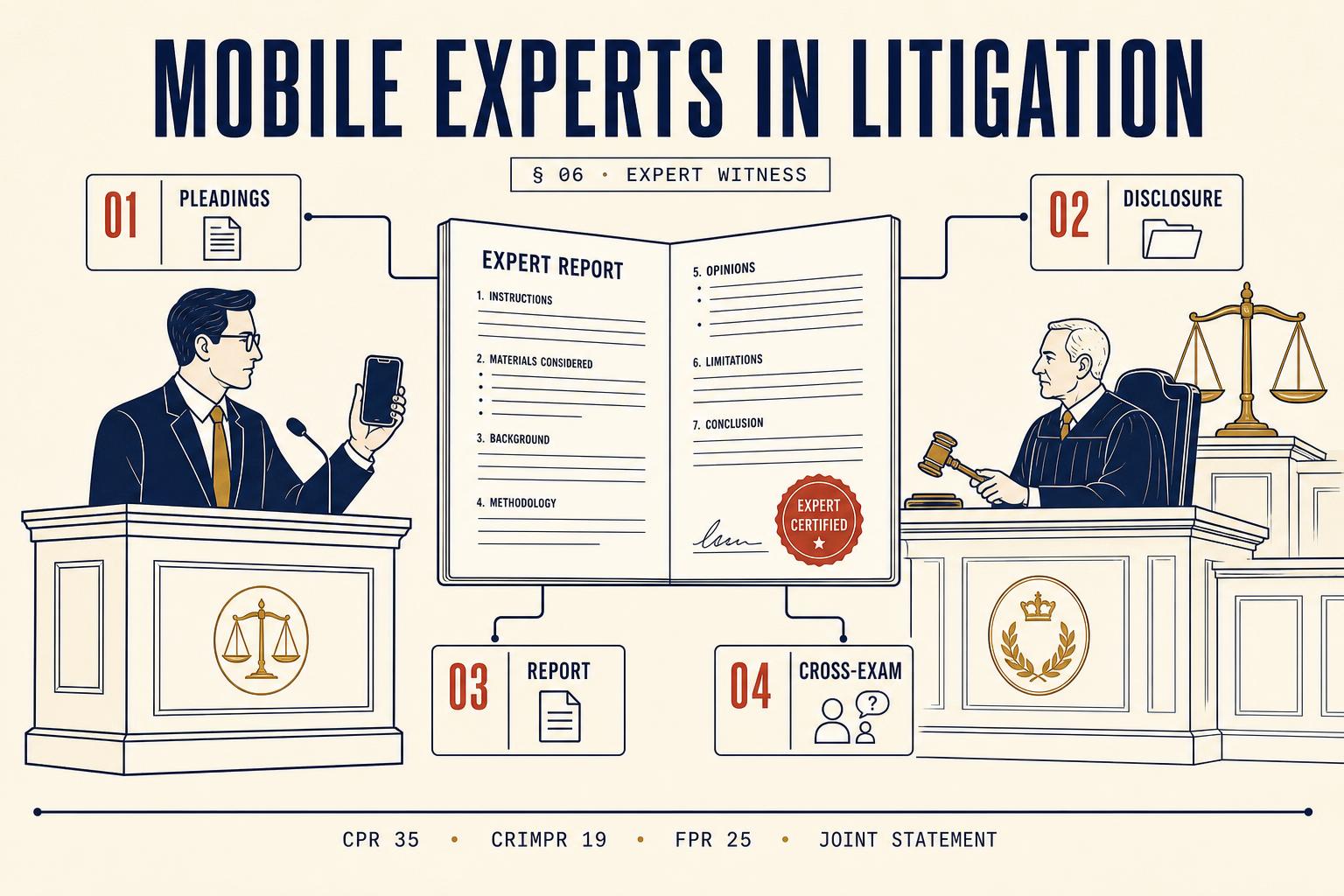
The four stages where an expert changes the case
- 01Pre-issue / pre-charge conference. Before pleadings close (civil) or before charge decision (criminal), a short expert conference identifies which factual assertions are testable against device data and which are not - and, decisively, what preservation notices need to go out today.
- 02Pleadings and directions. The expert shapes what should be pleaded, what should be pursued in Part 31 disclosure or under the criminal disclosure regime, and what preservation letters should be served on third parties (MNOs, cloud providers, employers).
- 03Report. A CPR Part 35, CrimPR Part 19 or FPR Part 25 compliant report answering the pleaded issues - no more, no less. The best reports concede their limits as clearly as they set out their findings.
- 04Trial. Cross-examination on methodology and, where a joint expert regime applies, a joint statement identifying areas of agreement and disagreement. The strongest experts narrow the disputed issues rather than expanding them.
What early instruction actually buys
| Stage | Cost of expert input | Cost of getting it wrong later |
|---|---|---|
| Pre-issue conference | 1–2 hours; often within existing scoping fee | Pleading assertions that turn out to be untestable |
| Preservation letters | Standard-form letter; hours not days | Data lost to routine retention windows (CDRs, backups, chats) |
| Disclosure drafting | Half-day expert review of proposed schedule | Court-refused specific-disclosure applications; wasted hearings |
| Interim application evidence | Expert statement in support | Injunctions refused for lack of forensic foundation |
| Post-report challenge | Joint statement; cross-examination attendance | Report excluded or heavily discounted at trial |
Civil litigation: where mobile evidence is now routine
- Commercial fraud - director and shareholder WhatsApp threads that contradict the pleaded case.
- Employment - post-termination confidentiality and restrictive-covenant breach evidence in Slack, WhatsApp and personal Gmail.
- Financial remedy - non-disclosure of assets exposed by cloud-photo timelines and location metadata.
- Harassment injunctions - pattern-of-conduct evidence assembled from device caches, notification history and DSAR records.
- Defamation - authorship attribution of anonymous posts via device forensics and platform disclosure.
Criminal defence: where the expert protects the client
In criminal cases, the mobile evidence is usually already in the prosecution's hands: a Cellebrite extraction, a cell site chart, a series of screenshots. The defence expert's job is not to reproduce that work but to interrogate it: was the extraction the deepest method available, and if not, has exculpatory material been left uncovered? Are the timestamps in local time or UTC - and does the report say which? Have gaps in the extraction been acknowledged? Is the cell site coverage plotted as a wedge or as a dot?
Most successful challenges to prosecution mobile evidence are not challenges to the underlying data. They are challenges to how the data has been characterised in the report. A defence expert who reads the prosecution report carefully often does more for the client than one who commissions fresh extractions.
Family Court: the fastest-growing area
Since President's Guidance on the use of digital evidence in family proceedings, and with the volume of allegations founded on WhatsApp screenshots, mobile experts are now instructed routinely in fact-finding hearings, in Schedule 1 disputes and in non-molestation applications. FPR Part 25 imposes tight controls on expert evidence, and applications are granted more readily where the expert's proposed methodology is proportionate to the issues. Overreaching methodology proposals - offering to extract every device belonging to both parties - tend to be refused; targeted proposals tend to be granted.
How to instruct effectively
- Send the pleadings, not a summary. What matters is what has actually been asserted, in the exact words used.
- Identify the questions the expert is being asked to answer - five is usually the right number, twenty is always the wrong number.
- Provide the device or its extraction file, plus any known passcodes recorded separately.
- State the forum, the applicable procedural rule (CPR 35 / CrimPR 19 / FPR 25) and the deadline.
- Copy the expert into subsequent orders and directions so scope drift is caught early.
Frequently asked questions
Before pleadings close, wherever practical. The window in which preservation still catches everything is measured in weeks, not months; once retention windows run, evidence is gone regardless of budget.
Most senior mobile forensic experts do both. The technical work is identical; the procedural framework and reporting requirements differ. Ensure the expert has attended court under the specific rule (CPR 35 / CrimPR 19 / FPR 25) that applies.
Yes, and in most Family Court and small-track civil matters this is now the default. The instruction is joint, the fees are shared, and the report is served on both parties simultaneously.
A CPR 35 expert's duty is to the court, not to the instructing party. Findings that do not help are still findings; the professional response is to consider the settlement implications rather than to shop for a friendlier report.
Preliminary conference and scoping: typically £600–£1,200. Extraction and analysis of a single device: £2,500–£6,000. Court attendance: charged daily. Legal aid rates are accepted for criminal and family work where prior authority is in place.