
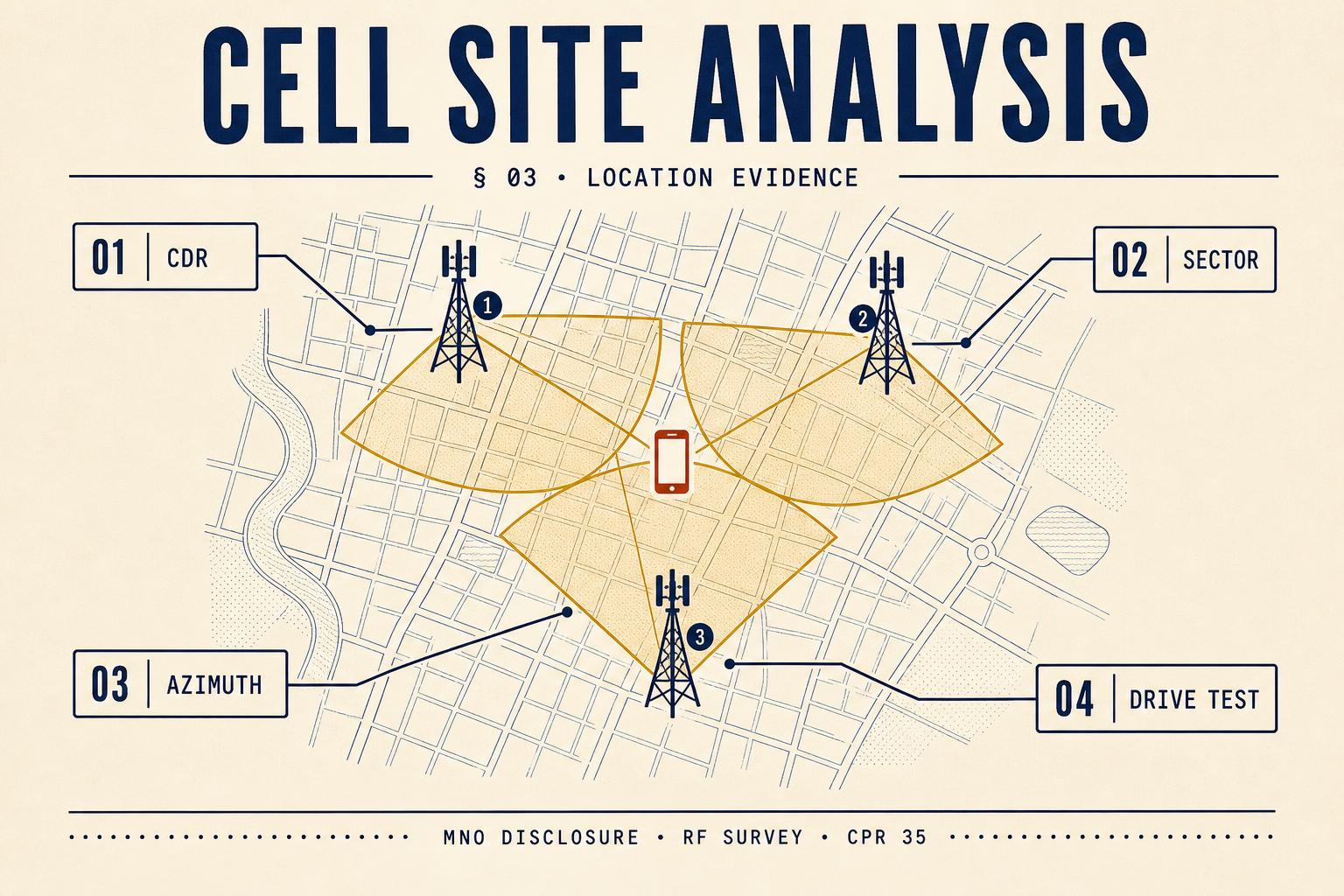
Every time a mobile handset makes a call, sends a text or opens a data session, the network records the mast and the sector the phone used. These records - call data records, or CDRs - are retained by the mobile network operators (MNOs) and disclosed on production of a court order. Analysed properly, they can place a phone in a broad area consistent with a mast's coverage, and they can rule out areas the phone cannot have been in. They cannot pinpoint a phone to a specific address, and no responsible report will suggest otherwise.
What the network actually records
- The mast (cell ID) and sector the handset used at the start of each call, SMS or data session.
- Sometimes, on 4G/5G, additional handovers during long calls (fewer records exist for short interactions).
- IMEI (device identifier) and IMSI (SIM identifier), which together tie the record to a specific handset/SIM pairing.
- The direction of the connection - mobile-originated or mobile-terminated - and, for voice, the duration.
- The other party's number, redacted or not depending on disclosure route.
What the CDR does not record is the phone's precise location. The coverage of a single sector is a wedge-shaped area - not a circle - that extends between roughly 100 metres in dense urban environments and several kilometres in rural ones, and its shape changes with terrain, buildings, foliage, weather, load on the network and the direction the antenna is pointing (its azimuth). Proper analysis requires the antenna configuration for the relevant date, which the MNO will disclose on production.
Where cell site evidence goes wrong in court
| Common error | Why it fails | The correct approach |
|---|---|---|
| Presenting the mast as a point on a map | Overstates precision; treats the mast as the location, not the area it covers | Show the sector as a wedge with realistic extent for the environment |
| Assuming the nearest mast is always used | Handsets frequently connect to a more distant mast under load, terrain or interference | Confirm actual sector used from the CDR; do not infer from geometry alone |
| Using a current network configuration for a historic incident | Networks change; sectors are re-aimed and masts decommissioned constantly | Request the antenna dataset for the exact date, not the analysis date |
| Treating the phone as the person | Devices are shared, lost, stolen or handed over; SIMs are moved between handsets | State conclusions in terms of the handset (IMEI) and the SIM (IMSI), not the person |
| Reporting without a drive test in contested areas | Predicted coverage differs from measured coverage, sometimes materially | Run an RF survey / drive test where the boundary of coverage is decisive |
What a defensible report contains
- 01MNO disclosure. CDRs for the target number(s) for the relevant window, plus antenna configuration for every mast referenced, for the exact date.
- 02Handset attribution. The IMEI/IMSI pairing over time, so handset swaps and SIM swaps are visible.
- 03Coverage modelling. Predicted sector coverage plotted with realistic extent, honestly acknowledging the uncertainty.
- 04RF survey. In contested areas, a drive test that measures actual coverage from the mast in question on comparable equipment.
- 05Written analysis. What the evidence supports, what it excludes, and - critically - what it does not address.
Cell site in the modern network
5G, small cells and Wi-Fi calling all complicate the picture. Small cells cover a single street or a single building; a hit on one can be highly probative. Wi-Fi calling routes voice traffic over any Wi-Fi network the handset is joined to, producing CDRs that do not reflect the phone's physical location at all. A defensible report accounts for these categories rather than ignoring them, and flags where the evidence is silent.
The most dangerous cell site reports are the ones that read like GPS traces. Coverage is an area with a probability distribution, not a dot on a map, and any report that pretends otherwise is a Court of Appeal point waiting to be taken.
Instructing cell site analysis
Cell site is a specialist discipline. General mobile forensics experience is not the same as cell site experience, and the two skill sets are not interchangeable. When instructing, ask directly: has the expert attended court on cell site matters, do they routinely conduct RF surveys, and can they produce examples of joint statements with opposing experts. If any of those answers is unclear, instruct differently.
Frequently asked questions
No. It can place a handset in an area consistent with the coverage of the sector used, at a given time. Attributing the handset to a person and the area to an address are separate evidential steps.
UK MNOs retain CDRs for approximately 12 months, though retention windows vary by operator and by data type. Requests should be made as early as possible; older data is often no longer available at any price.
A physical survey in which the examiner drives the area with calibrated measurement equipment, recording which sector actually serves each street on the incident date's antenna configuration. It converts predicted coverage into measured coverage.
Yes. 5G small cells and dynamic beamforming produce narrower, more precise coverage than 4G macro cells, which can be helpful; but Wi-Fi calling and dual-connectivity can also produce CDRs that do not reflect physical location. A modern report accounts for both.
Yes, and it is increasingly used in commercial fraud, family and employment matters. The evidential standard is the same as in criminal work; the disclosure route runs via the civil courts.